I still find it surprisingly hard to “prove” what AI has done for me in pounds and pence, and even in mental health terms. Not because it has not helped, but because the starting point matters. If you did not record your time properly before AI, you cannot cleanly compare “before” and “after”.
That is me.
I can feel the difference in my week. I can see it in the speed at which things move from idea to execution. But the most honest metric I have is time saved, and even that is slightly imperfect because I was never the sort of person who clocked every fragment of effort.
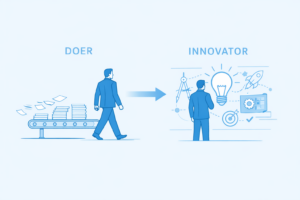
So my AI journey, outside of anything formal like VAi, has been more practical than philosophical. I have treated AI as a pressure-release valve and a leverage tool. I am not trying to become a futurist. I am trying to stop wasting hours on work that drains me, bores me, or simply does not justify the effort.
I started with a blunt question: what do I hate doing?
Not “what should I automate?” Not “what’s trendy?”
What do I hate doing?
Because the things you hate are the things you avoid. And the things you avoid either do not get done, or they get done late, under pressure, with resentment. That is the sort of workflow that quietly corrodes your week.
So I wrote a list. The boring admin. The repetitive drafting. The bits of writing that are necessary but not value-add. The tasks that take mental energy but do not require judgement.
Then I wrote a second list, which was even more revealing: what takes an inordinate amount of time, whether paid or unpaid?
The unpaid time is the first target. If you are serious about freeing yourself up, start with the work that steals hours and gives you nothing back. Once you claw time back there, the paid work becomes easier to re-engineer without fear.
I did not pretend I would get it right on Day 1
This is where I think many people fail. They treat AI like a one-step magic trick. Try it once, get a mediocre output, then declare it unreliable.
I took a different approach: I decided it would take days to think properly, not minutes.
Day 1 for me looks like this: I spend half an hour writing a messy “how we do it manually now” note. I include the irritating detail. I write what I wish I could remove. I set out what “better” would look like.
Then I leave it alone.
Day 2, I come back to it and improve it. Almost every time, I add something important that I missed when I was rushing. I also remove things that, on reflection, were not the real problem.
Day 3, only then do I put it into ChatGPT.
And I do not just say “help me”. I start talking to it properly. I tell it to interview me. I tell it what I do not want it doing. I tell it what matters: accuracy, tone, constraints, compliance, context.
That “interview me first” step is worth its weight in gold. It forces clarity. It prevents the AI from running off with assumptions. It also stops me from being lazy.
I ask for options, not answers
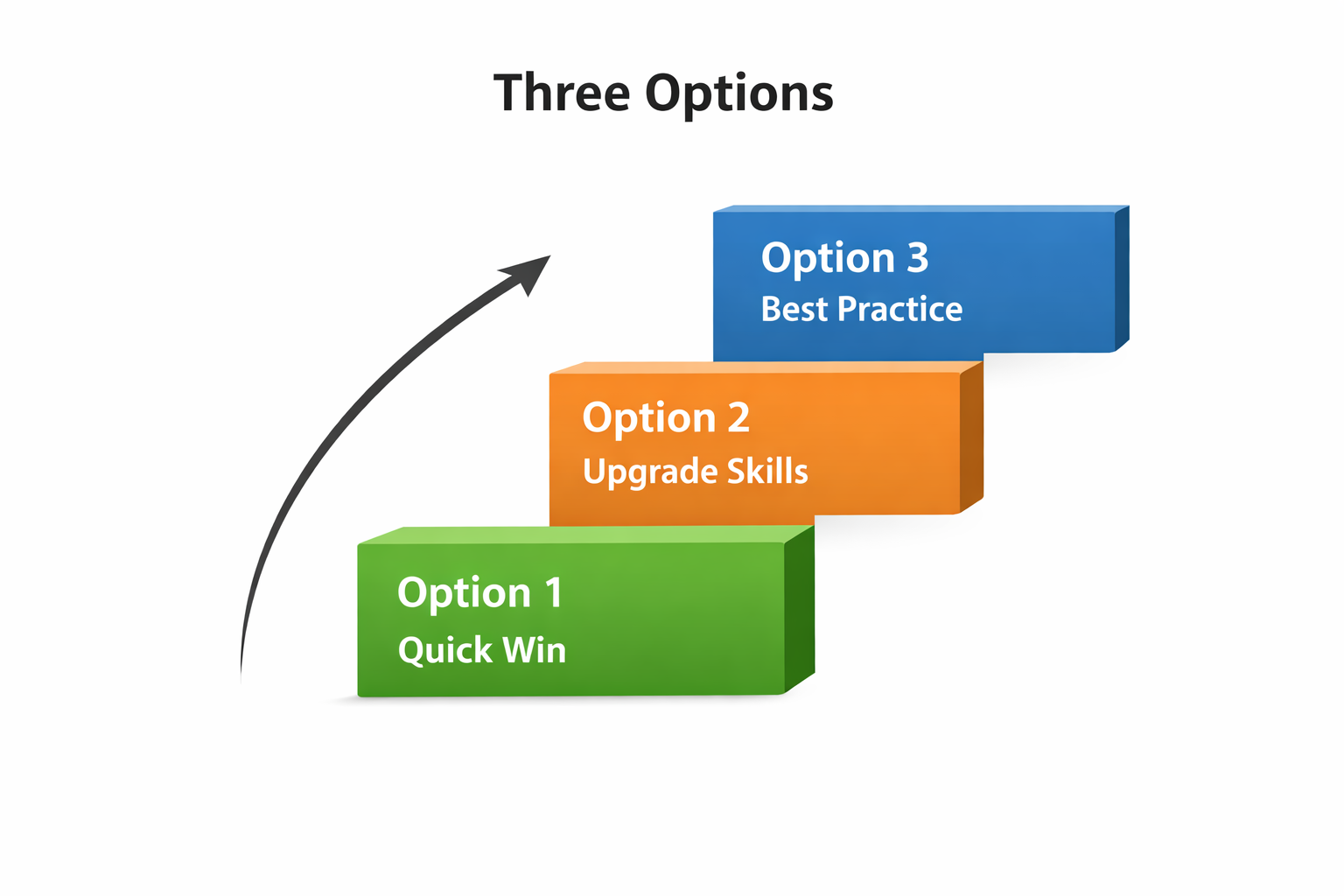
I rarely ask for “the solution”. I ask for three ways to do it.
Option 1: what can I do now, with my current skill level, today?
Option 2: what can I do with moderate skill and a bit of learning?
Option 3: what would the best version look like if I became genuinely competent at this, and how do I get there?
That framing does two things.
First, it stops me from overreaching. Second, it gives me a route map. I can take the quick win without losing sight of what “great” could look like.
I have learned to respect the quick win. It is not a compromise. It is the first brick in a bigger wall.
I treat AI like a compounding system
This is the part most people miss.
If you treat AI as a series of one-off prompts, you are always reinventing the wheel. You will get tired. You will drift back to manual work.
So I save the chat history.
I ask ChatGPT to summarise what we did, what we decided, and what the final output achieved. Then I save it on my computer. That becomes my “institutional memory”.
Later, when a better model comes out or a new tool appears, I do not start again. I say: “This was the problem. This is the journey we took. This was the output. How would you improve it now?”
That single habit has stopped me wasting ridiculous amounts of time.
I look for small wins that come back to me automatically
One of my favourite wins is simple: I set up AI so it comes back to me regularly.
For example, every Monday morning at 7am, I have it search for something specific and tell me if it found anything or not. Even a “nothing found” message is valuable because it proves something is happening without me doing it.
That matters psychologically.
It turns AI from a tool you must remember to use into a system that supports you. It becomes part of your operating rhythm.
And once it is in your rhythm, you start refining it. You tweak the instructions. You add a condition. You tighten the output. Regular small steps become long-term massive moves.
I keep my learning running in the background
My learning is not formal. It is opportunistic.
If I am driving, I listen to podcasts like Hard Fork, Everyday AI, and the AI Daily Brief. Not because I need to catch every trend, but because listening to how others use AI gives me ideas I would not generate in my own bubble.
That is another under-rated truth: your best use cases often come from someone else casually describing what they automated.
I capture “shower thoughts” like they are a business asset
This might be the most personal part.
Some of my best ideas arrive when I am not trying to think. In the shower. In bed. In the car.
So I keep paper near the shower, near the bed, and in the car. Not an app. Paper. Immediate. Frictionless.
I write down the flash thought, because those are often the real breakthroughs: “Why am I still doing that manually?” or “This step is pointless” or “That could be templated”.
Then I bring those notes to AI later, when I am at a screen and ready to build.
Where this has left me
I am still not brilliant at measuring AI in money. I am not even sure I want to be.
What I know is this: my time has become more controllable. I am less hostage to the tasks that used to drain me. I move faster from idea to output. I am more consistent. And the compounding effect of saved chats, small automations, and continual tweaks has made my work feel lighter, even when the workload is heavy.
AI, for me, has not been about replacing judgement. It has been about protecting it.
Judgement is the scarce resource. Energy is the scarce resource. Time is the scarce resource.
Everything else is a candidate for redesign.
And if you are looking for tips, that is mine in one line: start with what you hate, take small wins that repeat, and build a compounding library so you never start from zero again.