When I talk about AI, I am careful not to oversell it as a miracle. It can be wrong, it can be overconfident, and in professional work you have to keep a human firmly in the loop.
But used properly, AI has done something far more important for me than speeding up tasks.
It has made me more innovative.
And that has changed my relationship with my work, as well as my patience with people who are determined to block this new way of working.
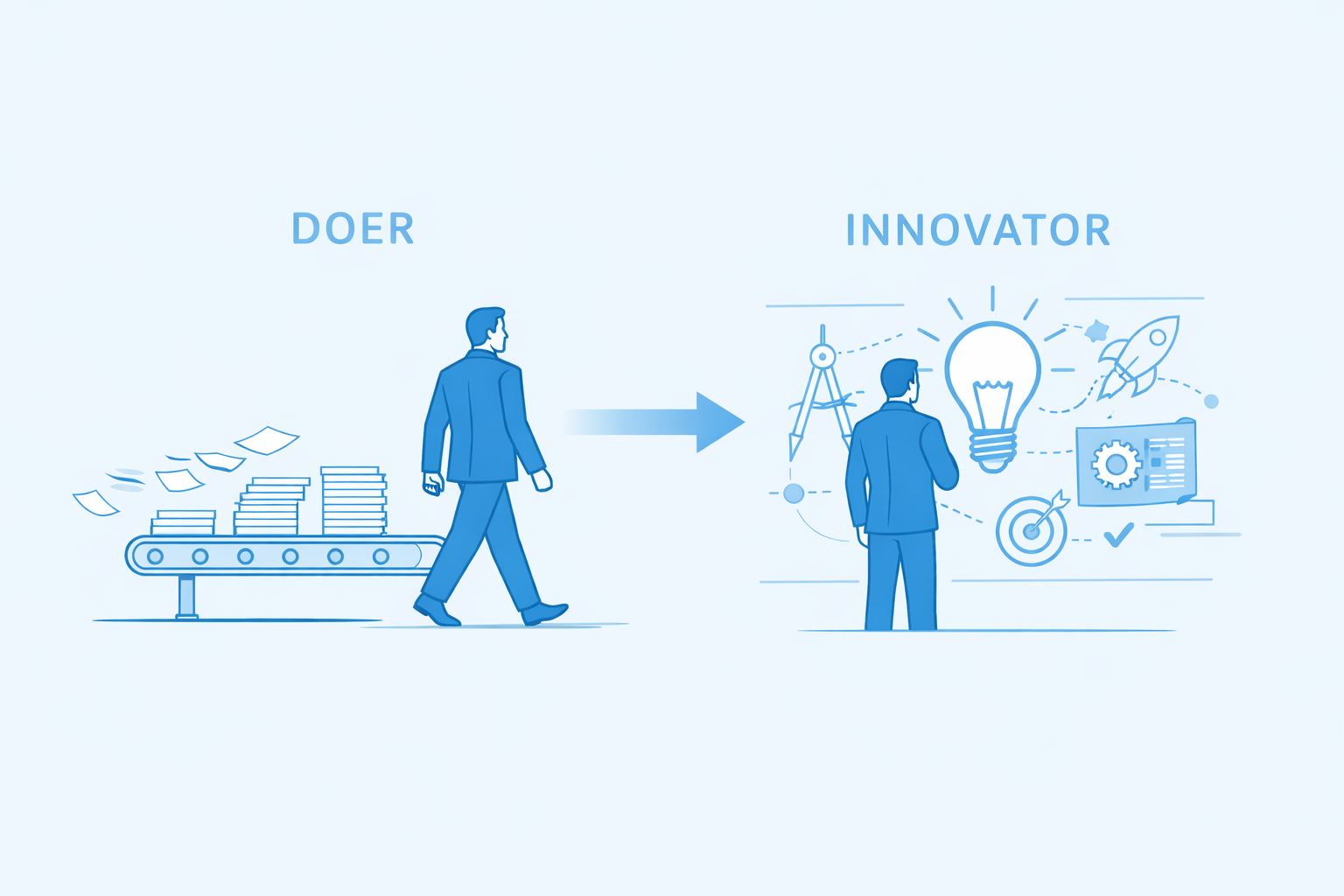
It pushed me out of “doer mode” and into “innovator mode”
For most of my career, like many professionals, I was a doer. Good at output. Good at delivery. Good at getting things done.
AI has nudged me into a different posture.
Less time grinding first drafts. Less time wrestling with structure. Less time staring at a blank page.
More time thinking:
What else could we do? What could we build? What new market does this open up? What new product or service could exist, which was impossible up to now?
That is a profound change.
When you are permanently busy, you do not innovate. You cope.
When you remove friction, you start to see options.
It has opened up new markets, new products, and new services
This is the part I do not think enough professionals have clocked yet.
AI is not only a tool for doing the same work faster, it is a tool for creating new work that did not previously exist, because the cost of creating it is now realistic.
In my own world, that has meant:
- spotting gaps in the market where clients and referrers are underserved
- packaging knowledge and experience into new products and services
- building frameworks and processes that can be delivered consistently
- producing content and guidance at a scale that would have been impossible before
It is not just productivity, it is product development.
And it has made me think like a builder again.
The habit-forming part is real
Once you feel the leverage, it becomes habit forming in the best sense.
You start to work differently without even meaning to.
You stop tolerating clunky processes.
You stop accepting that something is ”too hard” to improve.
You start (re-) building templates, playbooks, checklists, standard letters, workflows.
You start thinking in systems.
And because the feedback loop is so fast, you learn faster too. The learning becomes enjoyable, and you do more of it. That is the part people underestimate: AI does not only save time, it changes your appetite.
I have learned far more than I expected, and I enjoy it
In the last couple of years I have learned skills I would not have gone near before, because the time cost and the friction were too high.
Website development work is a good example. Not because AI makes me a web developer, but because it makes me capable. I can explore, test, restyle, fix, and build in small increments without having to rely on someone else for every step.
The same applies to documents. I now look at many professional documents and think: this is not clear enough, not structured well enough, not written for the human being receiving it. And instead of tolerating it, I restyle it.
That shift, from tolerating to improving, is a quiet form of innovation. It is a refusal to accept ‘good enough’ when better is achievable.
It has invigorated my interest in the profession
After a long time in any profession, it is easy to become jaded. You have seen patterns. You know how the story ends. You end up spending too much time dealing with process, compliance, repetition.
AI has re-energised my interest in insolvency and restructuring because it has reopened the creative side of the work.
Not creative in a fluffy sense, but creative in a practical sense:
- designing better client journeys
- producing clearer, faster, more consistent advice
- improving how we communicate risk
- building better decision frameworks
- turning decades of experience into usable tools and resources
It has made the profession feel alive again, because it makes improvement possible at pace.
And yes, it has made me less sympathetic to blockers
This is the honest part.
The more you experience what good AI use can do, the harder it becomes to listen to professionals who dismiss it with lazy criticisms:
‘It’s unreliable.’ ‘It’s risky.’ ‘It’ll never work in our profession.’ ‘We can’t because of compliance.’
Of course it is risky if you use it badly. So is email… So is Excel… So is giving junior staff a template and assuming it is right without review.
The answer is not to block it. The answer is to govern it.
The professionals who concern me are not the cautious ones. Sensible caution is healthy. The ones who concern me are the blockers who use ‘risk’ as a blanket excuse to avoid change, when what they really mean is:
‘I don’t want to learn a new way of working.’ ‘I don’t want my value questioned.’ ‘I don’t want to be pulled out of my comfort zone.’
I understand the fear. I even sympathise with it. But I do not think it is acceptable to let fear hold back progress, especially when the benefit to clients, teams, and service quality is so obvious.
The real shift: AI turns time into possibility
This is what I have come to believe.
AI does not just save time.
It converts time into possibility.
Possibility to build.
Possibility to innovate.
Possibility to learn.
Possibility to improve the client experience.
Possibility to create new markets and new services.
Possibility to do your job with more control over your life.
If you use it well, you become less of a doer.
And more of an innovator.
And once you get a taste for that, it changes you. It becomes a new standard for what work can feel like.
Hashtags
#AIInProfessionalServices #Innovation #FutureOfWork #ProfessionalServices #Insolvency #Restructuring #ContinuousImprovement #DigitalTransformation #HumanInTheLoop #LearningCulture